Marketing Budget Allocation: How to Maximize ROI Across Channels (Formulas & Benchmarks)
Quick Answer: How to Allocate a Marketing Budget for Maximum ROI
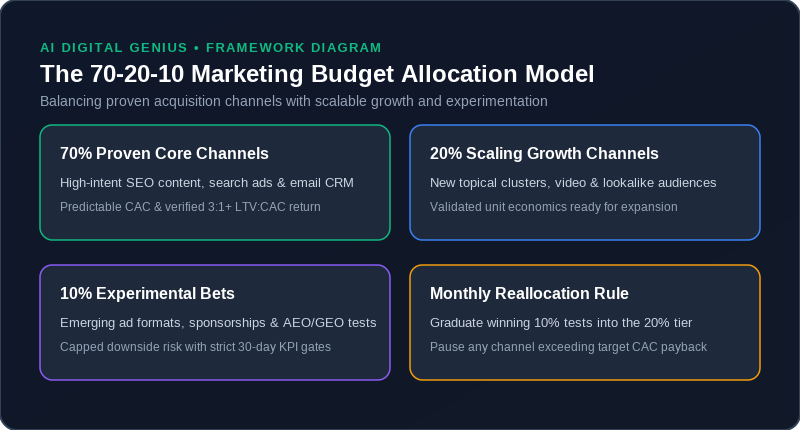
To maximize marketing ROI, allocate your budget using the proven 70-20-10 framework: invest 70% in proven, profitable acquisition channels (such as organic SEO content, high-intent search ads, and email retention), 20% in scaling promising growth channels, and 10% in experimental tests. Track LTV:CAC ratio (target 3:1 to 5:1) and CAC Payback Period monthly, and use our Free AI Marketing Plan Generator to model channel splits tailored to your industry.
Effective budget allocation is crucial for maximizing marketing ROI. In today's competitive landscape, strategic marketing spend can make or break a company's success. With the help of innovative tools like the ai business plan generator, businesses can now optimize their marketing efforts more efficiently.
However, allocating the marketing budget effectively remains a challenge for many businesses. It requires a deep understanding of the market, consumer behavior, and the latest marketing trends. By combining the 10 essential elements of a marketing plan with our AI Marketing Plan Generator and 10-minute marketing plan workflow, companies can significantly improve their marketing ROI and eliminate wasted ad spend.
Key Takeaways
- Effective budget allocation is key to maximizing marketing ROI.
- Strategic marketing spend is crucial in today's competitive landscape.
- Innovative tools can help optimize marketing efforts.
- Understanding the market and consumer behavior is vital for effective budget allocation.
- The right strategies can significantly improve marketing ROI.
The Strategic Importance of Marketing Budget Allocation
Effective marketing budget allocation is crucial for maximizing ROI in today's competitive business landscape. A well-planned marketing strategy hinges on the ability to distribute resources effectively across various channels and campaigns.
Why Smart Budget Distribution Matters
Smart budget distribution is essential for achieving marketing objectives. By allocating resources intelligently, businesses can amplify their reach and improve engagement. This, in turn, leads to better conversion rates and ultimately, a higher return on investment.
The Cost of Poor Allocation Decisions
Poor allocation decisions can have significant consequences, including lost opportunities and wasted resources. When budgets are not allocated effectively, marketing efforts may not reach their full potential, leading to suboptimal performance.
Lost Opportunities
Lost opportunities arise when marketing budgets are not allocated to the most effective channels. This can result in missed chances to engage with target audiences and drive conversions.
Wasted Resources
Wasted resources occur when budgets are allocated to underperforming campaigns or channels. This not only wastes financial resources but also diverts attention from more effective marketing strategies.
Measuring What Matters: Essential Marketing ROI Metrics
Measuring marketing success requires a deep dive into essential ROI metrics. To make informed decisions about budget allocation, marketers must understand the impact of their efforts across various channels and campaigns.
Customer Acquisition Cost (CAC)
Customer Acquisition Cost (CAC) is a crucial metric that represents the total cost of acquiring a new customer. This includes marketing and sales expenses. A lower CAC indicates more efficient marketing efforts.
Customer Lifetime Value (CLV) & Core ROI Formulas
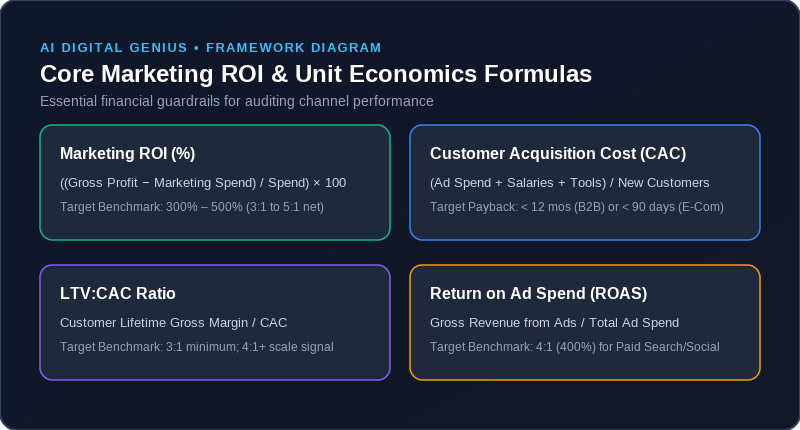
Customer Lifetime Value (CLV) measures the total gross margin a customer generates over their relationship with your business. Comparing CLV against CAC reveals whether your marketing budget is compounding profitably or burning cash. Use these four core formulas to audit every channel in your marketing plan:
| Metric | Exact Formula | Healthy Target Benchmark |
|---|---|---|
| Marketing ROI (%) | ((Gross Profit − Marketing Spend) / Marketing Spend) × 100 |
300% – 500% (3:1 to 5:1 net return) |
| Customer Acquisition Cost (CAC) | (Total Channel Ad Spend + Marketing Salaries & Tools) / New Customers Acquired |
Payback within < 12 months (B2B) or < 90 days (E-Commerce) |
| LTV:CAC Ratio | Customer Lifetime Gross Margin / CAC |
3:1 minimum; 4:1+ indicates room to scale spend |
| Return on Ad Spend (ROAS) | Gross Revenue Attributable to Ads / Total Ad Spend |
4:1 (400%) for paid search & paid social |
Return on Ad Spend (ROAS)
Return on Ad Spend (ROAS) calculates the revenue generated by each dollar spent on advertising. It's a vital metric for evaluating the effectiveness of ad campaigns and optimizing ad spend.
Conversion Rates Across Channels
Understanding conversion rates across different marketing channels is essential for identifying which channels drive the most valuable customer actions. This insight allows marketers to allocate their budget more effectively.
By focusing on these key metrics, businesses can gain a clearer picture of their marketing performance and make data-driven decisions to improve their ROI.
📈 Margin & Price Leverage Insight
Marketing ROI is heavily dictated by your pricing power. McKinsey research demonstrates that a 1% price improvement lifts operating profits by ~8%—far outpacing cost-cutting. Learn how pricing interacts with channel spend in the marketing mix and review the complete 4 Ps of marketing framework.
Data-Driven Budget Allocation Strategies That Work
Data-driven strategies are revolutionizing how companies allocate their marketing budgets. By leveraging historical data, predictive analytics, and agile management practices, businesses can significantly enhance their return on investment (ROI).
Learning From Historical Performance
Analyzing past marketing campaigns helps identify successful strategies and areas for improvement. By understanding what worked and what didn't, businesses can make informed decisions about future budget allocations.
Implementing Predictive Analytics
Predictive analytics enables companies to forecast future trends and customer behaviors. This allows for more accurate budget allocation, ensuring that resources are directed towards the most promising marketing channels.
Adopting Agile Budget Management
Agile budget management involves regularly reviewing and adjusting budget allocations based on real-time performance data. This approach ensures that marketing efforts remain optimized and responsive to changing market conditions.
Regular Review Cycles
Implementing regular review cycles is crucial for agile budget management. These cycles allow businesses to assess the effectiveness of their marketing strategies and make necessary adjustments.
Reallocation Triggers
Identifying reallocation triggers is essential for ensuring that budget adjustments are made promptly in response to performance data. This could include significant changes in conversion rates or customer acquisition costs.
By adopting these data-driven strategies, businesses can maximize their marketing ROI and stay competitive in a rapidly evolving market.
- Key benefits of data-driven budget allocation include improved ROI and enhanced marketing effectiveness.
- Businesses can leverage historical data to inform future marketing decisions.
- Predictive analytics and agile budget management are crucial for optimizing marketing spend.
Maximizing ROI Across Different Marketing Channels
The key to maximizing ROI lies in optimizing marketing efforts across multiple channels. In today's diverse marketing landscape, understanding how to effectively allocate resources across different channels is crucial for achieving the best possible return on investment.
Digital Channel Optimization
Digital channels offer a wide range of opportunities for ROI maximization. By focusing on the most effective digital channels, businesses can significantly enhance their marketing performance.
Paid Search
Paid search remains one of the most effective digital marketing channels. By targeting specific keywords and demographics, businesses can increase their visibility and drive conversions. Optimizing ad copy and landing pages is crucial for improving conversion rates.
Social Media
Social media platforms provide a unique opportunity to engage with customers and promote products. Targeted social media campaigns can help businesses reach their target audience more effectively.
Email Marketing
Email marketing continues to be a highly effective channel for ROI maximization. By creating personalized and relevant content, businesses can improve customer engagement and drive sales.
Traditional Channel Considerations
While digital channels are increasingly important, traditional channels such as print and broadcast media still have a place in many marketing strategies. Understanding the strengths and weaknesses of these channels is essential for effective budget allocation.
| Channel | Strengths | Weaknesses |
|---|---|---|
| Paid Search | Targeted, measurable | Competitive, costly |
| Social Media | Engaging, broad reach | Time-consuming, difficult to measure ROI |
| Email Marketing | Personalized, cost-effective | Limited reach if not optimized |
Creating Synergy Between Channels
To truly maximize ROI, businesses must create synergy between different marketing channels. By integrating their marketing efforts across channels, companies can enhance their overall marketing effectiveness.
For instance, a campaign that combines paid search, social media, and email marketing can create a cohesive brand message that resonates with customers across multiple touchpoints.
How AI Business Plan Generators Transform Marketing Budgeting
With the advent of AI technology, marketing budgeting has become more sophisticated, allowing for real-time adjustments and optimizations. The traditional methods of budget allocation are being replaced by more dynamic and intelligent systems.
The Evolution of Budget Planning Tools
Budget planning tools have undergone significant transformations over the years. From simple spreadsheet-based models to complex AI-driven systems, the evolution has been remarkable. AI business plan generators now offer the capability to analyze vast amounts of data, providing insights that were previously unattainable.
Core Features of Modern AI Solutions
Modern AI solutions for marketing budget allocation come equipped with advanced features such as predictive analytics, market trend analysis, and performance forecasting. These features enable businesses to make informed decisions and optimize their marketing spend.
Real-Time Adjustment Capabilities
One of the key benefits of using AI in marketing is the ability to make real-time adjustments to budget allocations. This is achieved through:
Market Condition Responses
AI systems can respond to changing market conditions by reallocating budget to the most effective channels. This ensures that marketing efforts remain optimized and aligned with current market dynamics.
Performance-Based Reallocation
By continuously monitoring campaign performance, AI business plan generators can reallocate budget to maximize ROI. This data-driven approach ensures that marketing spend is always optimized for the best possible outcomes.
The integration of AI business plan generators into marketing budgeting processes represents a significant step forward in budget planning tools. By leveraging these advanced technologies, businesses can achieve more efficient and effective marketing budget allocation.
Selecting and Implementing the Right AI Business Plan Generator
Choosing the right AI business plan generator is crucial for maximizing your marketing ROI. With the increasing complexity of marketing strategies and the vast amount of data available, an effective AI tool can streamline your planning process and enhance decision-making.
Key Features to Look For
When selecting an AI business plan generator, there are several key features to consider:
- Customization: The ability to tailor the tool to your specific business needs.
- Data Integration: Seamless integration with your existing data systems.
- Predictive Analytics: Advanced capabilities to forecast market trends and customer behavior.
- User Interface: An intuitive and user-friendly interface for easy adoption across your team.
Integration Requirements
To ensure the AI business plan generator works effectively within your existing infrastructure, consider the following integration requirements:
| Integration Type | Description | Benefits |
|---|---|---|
| Data Sync | Real-time data synchronization with your CRM and other marketing tools. | Ensures up-to-date data for accurate planning. |
| API Connectivity | Ability to connect with various APIs for enhanced functionality. | Expands the tool's capabilities and customization options. |
| Cloud Compatibility | Compatibility with cloud-based services for scalability and flexibility. | Facilitates remote access and collaboration. |
Implementation Best Practices
Successful implementation of an AI business plan generator involves several best practices:
Data Preparation Steps
- Clean and organize your existing data to ensure accuracy.
- Define data standards and protocols for future data entry.
- Conduct a preliminary analysis to identify key data points.
Team Training Essentials
Training your team is crucial for the effective use of the AI business plan generator. Focus on:
- Understanding the tool's capabilities and limitations.
- Practical application through hands-on training sessions.
- Ongoing support to address any questions or issues.
By carefully selecting and implementing the right AI business plan generator, businesses can significantly enhance their marketing strategies and improve ROI.
From Planning to Execution: Making Your AI Insights Actionable
Turning AI insights into actionable strategies is crucial for maximizing marketing ROI. As businesses increasingly rely on AI for budget allocation decisions, the challenge lies in effectively executing these data-driven plans.
Translating AI Recommendations into Strategy
The first step in making AI insights actionable is to translate the recommendations into a coherent marketing strategy. This involves understanding the AI's suggestions, such as reallocating budget to high-performing channels or adjusting campaign targeting parameters.
Marketers must then align these recommendations with their overall business objectives, ensuring that the AI-driven strategies support broader goals like customer acquisition or brand awareness.
Creating Feedback Loops
To refine and improve AI insights over time, it's essential to create feedback loops. This involves monitoring the performance of AI-driven marketing decisions and feeding the results back into the AI system.
"The key to successful AI implementation lies in continuous learning and adaptation."
Measuring Implementation Success
Measuring the success of AI-driven marketing strategies involves tracking both short-term indicators and long-term value creation.
Short-Term Indicators
- Campaign performance metrics such as click-through rates and conversion rates
- Initial ROI improvements
Long-Term Value Creation
- Customer lifetime value (CLV) enhancements
- Brand equity growth
By focusing on both immediate results and long-term impact, marketers can fully realize the potential of their AI insights and continually optimize their marketing budget allocation.
Case Studies: Marketing Budget Transformation Success Stories
Transforming marketing budget allocation can revolutionize a company's ROI, as seen in numerous success stories across various business sizes. Businesses have achieved significant improvements in marketing effectiveness by rethinking their budget allocations.
Small Business Breakthrough
A small e-commerce business saw a 300% increase in sales after reallocating its marketing budget towards social media advertising and influencer partnerships. Key metrics included:
- A 50% reduction in Customer Acquisition Cost (CAC)
- A 200% increase in website traffic
Mid-Market Company Turnaround
A mid-market company in the software industry achieved a 25% increase in lead generation by implementing AI-driven budget allocation tools. This led to:
- A 15% improvement in sales conversion rates
- A 10% reduction in overall marketing spend
Enterprise-Level Optimization
- An enterprise-level retail brand optimized its marketing budget using predictive analytics, resulting in a 12% increase in overall ROI. Notable achievements included:
- A 20% improvement in email marketing conversion rates
- A 15% increase in customer retention rates
Before and After Metrics
- Comparing the before and after metrics for these case studies reveals significant improvements in marketing efficiency and ROI. For instance, the small business saw its ROI increase from 150% to 450%.
| Metric | Before | After |
|---|---|---|
| CAC | $50 | $25 |
| Conversion Rate | 2% | 5% |
Implementation Challenges Overcome
- Despite the successes, these businesses faced challenges such as data integration issues and resistance to change. By adopting agile methodologies and leveraging AI tools, they were able to overcome these hurdles and achieve their marketing goals.
Overcoming Common Budget Optimization Roadblocks
Effective budget optimization is crucial for maximizing ROI, yet it's fraught with challenges. Companies often encounter various obstacles that can hinder their ability to allocate marketing budgets efficiently.
Dealing with Incomplete Data
One of the primary challenges in budget optimization is dealing with incomplete or inaccurate data. To overcome this, businesses can implement robust data collection and validation processes. This might involve integrating multiple data sources and using advanced analytics tools to fill gaps and correct inaccuracies.
Managing Cross-Department Expectations
Different departments within an organization often have competing priorities and expectations regarding budget allocation. To manage these expectations, it's essential to establish clear communication channels and involve all relevant stakeholders in the budgeting process.
Adapting to Rapid Market Changes
Market conditions can change rapidly, making it necessary to adjust budget allocations accordingly. Businesses can adopt agile budgeting practices to respond quickly to these changes, ensuring that their marketing spend remains effective.
Building Executive Buy-In
Securing executive buy-in is critical for successful budget optimization. This can be achieved by presenting clear, data-driven insights that demonstrate the potential ROI of optimized budget allocations.
| Roadblock | Solution |
|---|---|
| Incomplete Data | Robust data collection and validation |
| Cross-Department Expectations | Clear communication and stakeholder involvement |
| Rapid Market Changes | Agile budgeting practices |
| Lack of Executive Buy-In | Data-driven insights and ROI demonstration |
The Future of Marketing Budget Allocation
As we look to the future, marketing budget allocation is poised to undergo significant transformations driven by technological advancements. The integration of emerging technologies will revolutionize how businesses allocate their marketing resources, making processes more efficient and effective.
Emerging AI and Machine Learning Applications
The future of marketing budget allocation will be heavily influenced by AI and machine learning applications. These technologies will enable businesses to analyze vast amounts of data, predict consumer behavior, and make informed decisions about budget distribution.
Predictive Modeling Advancements
Predictive modeling will play a crucial role in future marketing budget allocation. By leveraging historical data and real-time market trends, businesses will be able to forecast the effectiveness of different marketing strategies and allocate their budgets accordingly.
Integration with Customer Experience Platforms
The integration of budget allocation tools with customer experience platforms will become increasingly important. This integration will allow businesses to create seamless, personalized experiences for their customers while optimizing their marketing spend.
Personalization at Scale
One of the key benefits of integrating budget allocation tools with customer experience platforms is the ability to achieve personalization at scale. By leveraging AI-driven insights, businesses can tailor their marketing efforts to individual customers, enhancing engagement and conversion rates.
Dynamic Budget Shifting
The future will also see the rise of dynamic budget shifting, where businesses can rapidly adjust their marketing budgets in response to real-time market data and performance metrics. This agility will enable companies to capitalize on emerging opportunities and mitigate potential losses.
Conclusion: Transforming Your Marketing ROI Through Intelligent Budget Allocation
Effective marketing ROI is crucial for businesses to thrive in today's competitive landscape. Intelligent budget allocation plays a pivotal role in achieving this goal. By leveraging data-driven strategies and embracing AI business plan generators, companies can significantly enhance their marketing effectiveness.
AI business plan generators have revolutionized the way businesses approach marketing budget allocation. These tools enable organizations to make informed decisions, optimize their marketing spend, and drive better ROI. As the marketing landscape continues to evolve, adopting intelligent budget allocation strategies will be key to staying ahead of the competition.
By implementing the insights and strategies outlined in this article, businesses can transform their marketing ROI. Embracing AI-driven solutions will empower marketers to allocate their budgets more efficiently, drive higher returns, and achieve their marketing objectives.
FAQ
What is the importance of budget allocation in marketing?
Budget allocation is crucial in marketing as it directly impacts Return on Investment (ROI). Effective budget allocation ensures that marketing spend is optimized to achieve the best possible outcomes.
How does AI optimize marketing spend?
AI optimizes marketing spend by analyzing historical performance data, predicting future trends, and making real-time adjustments to budget allocation. This enables businesses to maximize their ROI across different marketing channels.
What are the key metrics to measure marketing ROI?
The key metrics to measure marketing ROI include Customer Acquisition Cost (CAC), Customer Lifetime Value (CLV), Return on Ad Spend (ROAS), and conversion rates across different channels.
How can businesses allocate their marketing budget effectively?
Businesses can allocate their marketing budget effectively by learning from historical performance data, implementing predictive analytics, and adopting agile budget management practices.
What is the role of AI business plan generators in marketing budgeting?
AI business plan generators revolutionize marketing budgeting by providing real-time adjustment capabilities, responding to market conditions, and reallocating budget based on performance.
How can businesses select and implement the right AI business plan generator?
Businesses can select and implement the right AI business plan generator by looking for key features, considering integration requirements, and following best practices for implementation, including data preparation and team training.
How can AI-generated insights be translated into actionable marketing strategies?
AI-generated insights can be translated into actionable marketing strategies by creating feedback loops, measuring implementation success, and considering both short-term indicators and long-term value creation.
What are the common challenges in optimizing marketing budget?
Common challenges in optimizing marketing budget include dealing with incomplete data, managing cross-department expectations, adapting to rapid market changes, and building executive buy-in.
What is the future of marketing budget allocation?
The future of marketing budget allocation involves emerging applications of AI and machine learning, advancements in predictive modeling, and integration with customer experience platforms, enabling personalization at scale and dynamic budget shifting.
Written & Reviewed by Soban Raheel
Founder & Lead StrategistSoban Raheel builds web developer utilities, SEO automation workflows, and data-driven marketing frameworks at AI Digital Genius. Every guide is tested against live search console metrics, RFC/W3C specifications, and practical small-business workflows before publication.
Expert Resources & References
Marketing Planning_Tools
- Free AI Marketing Plan Generator
Generate a tailored multi-channel marketing plan and budget split in minutes.
- Marketing Plan Guide, Template & Examples
Step-by-step guide with copyable budget templates and annual planning checklists.
- The 4 Ps of Marketing & Pricing Power Guide
Learn how pricing leverage interacts with promotional spend in your marketing mix.
- 10 Essential Elements of a Successful Marketing Plan
Complete breakdown of the 10 core pillars every high-converting marketing plan needs.
Ready to Create Your Marketing Plan?
Use our free AI-powered marketing plan generator to create a comprehensive, data-driven marketing strategy tailored to your business.
Generate Your Marketing Plan