10 Essential Elements of a Successful Marketing Plan
Quick Answer: What Are the 10 Essential Elements of a Marketing Plan?
Every high-performing marketing plan connects 10 core components into one measurable system: (1) market & competitor research, (2) SMART objectives & KPIs, (3) positioning & value proposition, (4) the 4 Ps marketing mix, (5) messaging & content pillars, (6) acquisition channels, (7) 70/20/10 budget allocation, (8) 90-day execution timeline, (9) attribution & tracking, and (10) quarterly contingency triggers. You can generate a tailored 10-section draft in minutes using our Free AI Marketing Plan Generator.
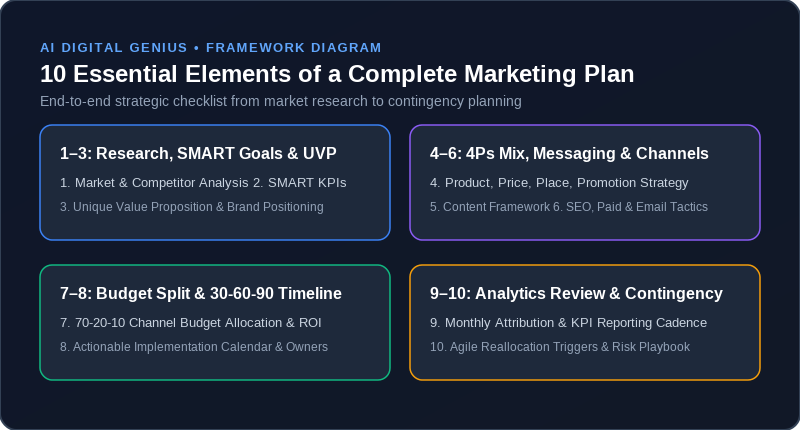
10-Element Marketing Plan Summary & KPI Checklist
Use this reference table to audit whether your current strategy has an owner, deliverable, and measurable KPI for every stage of the customer lifecycle:
| # | Marketing Plan Element | Core Deliverable | Primary KPI / Benchmark |
|---|---|---|---|
| 1 | Market & ICP Research | Buyer personas, TAM/SAM, competitor gaps | ICP interview count & win-rate % |
| 2 | SMART Objectives | 90-day & annual pipeline targets | SQLs/month & revenue target |
| 3 | Value Proposition | Differentiated positioning statement | Landing page conversion rate (2%–5%+) |
| 4 | 4 Ps Marketing Mix | Product, Price, Place, Promotion alignment | Gross margin & ARPU |
| 5 | Messaging & Content | Pillar-and-spoke topical clusters | Organic non-brand clicks |
| 6 | Channel Tactics | SEO, search ads, email, social cadence | Channel CAC & CTR |
| 7 | Budget Allocation | 70% core / 20% scale / 10% test split | LTV:CAC (3:1+) & ROAS |
| 8 | Execution Timeline | Sprint calendar with owners & deadlines | On-time campaign launch % |
| 9 | Analytics & Tracking | UTM taxonomy, CRM funnel attribution | CAC Payback (<12 months) |
| 10 | Contingency Rules | Pause/scale thresholds per channel | Max CPA guardrail variance |
Why a Documented Marketing Plan Outperforms Ad-Hoc Campaigns
Documenting these ten elements turns isolated marketing tasks into a repeatable growth loop. A marketing plan serves as a roadmap, guiding businesses towards their goals and helping them navigate the complexities of the market.
Why Every Business Needs a Structured Marketing Approach
Every business, regardless of size or industry, benefits from a structured marketing approach. This involves understanding your target audience, analyzing competitors, and identifying unique selling points. By doing so, businesses can create effective marketing strategies that resonate with their audience and drive results. Utilizing tools like an ai business plan generator or business plan generator free can streamline this process, making it easier to develop a comprehensive marketing plan.
The ROI of Well-Executed Marketing Plans
A well-executed marketing plan can significantly improve a business's ROI. By setting clear objectives and measuring performance, businesses can optimize their marketing efforts and allocate resources more efficiently. This not only enhances their marketing performance but also contributes to the overall growth and profitability of the business.
By adopting a structured marketing approach and leveraging the right tools, businesses can maximize their marketing ROI and achieve their objectives more effectively.
Essential Element #1: Clear Market Research and Analysis
Clear market research and analysis are crucial for developing a marketing plan that resonates with the target audience. Understanding the market landscape, including customer needs and competitor activity, enables businesses to create targeted and effective marketing strategies.
Identifying Your Target Audience
Identifying the target audience is a critical step in market research. This involves understanding demographic characteristics, preferences, and behaviors. By knowing who your customers are, you can tailor your marketing efforts to meet their needs effectively.
Analyzing Competitors and Market Trends
Analyzing competitors and market trends provides valuable insights into the competitive landscape. This analysis helps businesses identify opportunities and threats, allowing them to adjust their marketing strategies accordingly.
Tools for Effective Market Research
Several tools can aid in conducting effective market research. These include:
- Surveys and focus groups
- Social media listening tools
- Competitor analysis software
- Market trend reports
Using these tools, businesses can gather comprehensive data on their target audience and market trends.
| Tool | Purpose | Benefits |
|---|---|---|
| Surveys and Focus Groups | Gather direct feedback from customers | Provides firsthand insights into customer needs and preferences |
| Social Media Listening Tools | Monitor social media conversations | Helps in understanding customer sentiment and trends |
By leveraging these tools and techniques, businesses can conduct thorough market research and analysis, ultimately informing their marketing strategies with data-driven insights.
💡 Strategic Framework Deep Dive
To ensure your objectives are supported by practical operational decisions, align your strategy with the foundational 4 Ps of marketing (Product, Price, Place, Promotion). Read our complete guide to building a high-performing marketing mix with real-world examples and KPI benchmarks.
Essential Element #2: Defined Marketing Objectives and KPIs
To achieve marketing success, businesses must establish clear objectives and relevant KPIs. Defined marketing objectives provide direction and focus for marketing efforts, while KPIs enable businesses to measure progress and adjust strategies accordingly.
Setting SMART Marketing Goals
Setting SMART (Specific, Measurable, Achievable, Relevant, Time-bound) marketing goals is crucial for creating effective marketing strategies. By doing so, businesses can ensure their objectives are clear, actionable, and aligned with overall business goals.
Selecting the Right Key Performance Indicators
Choosing the right KPIs is vital for measuring marketing success. Common KPIs include website traffic, conversion rates, social media engagement, and customer acquisition costs. The selected KPIs should align with the marketing objectives and provide actionable insights.
Tracking and Measuring Success
Once KPIs are established, businesses must track and measure their performance regularly. This involves using analytics tools to monitor progress, identify areas for improvement, and adjust marketing strategies as needed. Regular review cycles help ensure marketing efforts remain on track and aligned with business objectives.
By defining clear marketing objectives and selecting relevant KPIs, businesses can create a focused marketing strategy that drives results. Utilizing tools like a project plan generator can further streamline the marketing planning process, ensuring that objectives are met efficiently.
Essential Element #3: Unique Value Proposition and Positioning
To stand out from the competition, businesses must develop a clear and compelling unique value proposition. This involves identifying what sets your product or service apart from others in the market and communicating this difference effectively to your target audience.
Crafting a Compelling Value Proposition
A compelling value proposition is more than just a slogan; it's a statement that clearly communicates the benefits and unique value that your business offers to customers. To craft one, you need to understand your customers' needs, preferences, and pain points. This can be achieved through market research and analysis.
Positioning Strategies That Stand Out
Positioning strategies are crucial for differentiating your brand in a crowded market. Effective positioning involves creating a unique identity for your brand that resonates with your target audience. Here are some key strategies:
- Identify your unique selling points
- Understand your target audience's needs
- Analyze your competitors
| Positioning Strategy | Description | Example |
|---|---|---|
| Unique Selling Proposition (USP) | Highlight what makes your product/service unique | "The only eco-friendly cleaning product on the market." |
| Benefit-Oriented Positioning | Focus on the benefits that your product/service offers | "Our software saves you 30% of your time." |
| Competitor-Based Positioning | Position your brand in relation to your competitors | "Unlike Brand X, our product is made with organic ingredients." |
By leveraging these strategies and crafting a compelling unique value proposition, businesses can effectively differentiate themselves and attract their target audience.
Essential Element #4: Comprehensive Marketing Mix Strategy
A well-crafted marketing mix strategy is crucial for businesses aiming to effectively reach and engage their target audience. The marketing mix, commonly known as the 4Ps (Product, Price, Promotion, and Place), forms the core of a company's marketing efforts, enabling businesses to deliver value to customers and achieve their marketing objectives.
To develop a comprehensive marketing mix, businesses must consider several key elements.
Product Strategy Considerations
Product strategy involves creating offerings that meet the needs and desires of the target market. This includes:
- Defining product features and benefits
- Determining product lifecycle stages
- Developing product branding and packaging
A strong product strategy ensures that the product or service stands out in a competitive market and satisfies customer needs.
Pricing Strategy Development
Pricing is a critical component of the marketing mix, as it directly impacts revenue and profitability. Effective pricing strategies consider:
- Cost-based pricing
- Value-based pricing
- Competitive pricing
Businesses must choose a pricing strategy that aligns with their overall marketing objectives and brand positioning.
Promotion and Distribution Channels
Promotion and distribution are vital for ensuring that products or services reach the target audience effectively. This involves:
- Selecting appropriate promotional channels (e.g., social media, advertising)
- Developing distribution strategies (e.g., online, retail)
By integrating these elements, businesses can create a cohesive marketing mix that drives customer engagement and ultimately, business success.
Essential Element #5: Content Marketing and Messaging Framework
A well-crafted content marketing strategy is crucial for engaging your target audience effectively. It involves creating and distributing valuable, relevant, and consistent content to attract and retain a clearly defined audience.
Content Types and Formats for Different Stages
Different stages of the buyer's journey require different types of content. For instance, blog posts and social media content are effective for awareness, while case studies and whitepapers are better suited for consideration and decision stages.
Creating a Consistent Brand Voice
Your brand voice is how your brand communicates with your audience. It's essential to maintain a consistent tone across all content types to build trust and recognition. This involves defining your brand's personality and language.
Content Calendar Planning
A content calendar helps you plan, organize, and schedule your content in advance. It ensures that you're consistently publishing content and helps you avoid last-minute scrambles. When planning your content calendar, consider the types of content, publishing frequency, and distribution channels.
By incorporating these elements, you can develop a robust content marketing and messaging framework that resonates with your audience and drives results.
Essential Element #6: Digital Marketing Channels and Tactics
As the world becomes increasingly digital, incorporating effective digital marketing channels is vital for success. A well-rounded marketing plan must include a robust digital marketing strategy to reach and engage the target audience.
Social Media Strategy
A key component of digital marketing is a well-planned social media strategy. This involves identifying the right platforms for your audience, creating engaging content, and using paid advertising to amplify your reach. Effective social media marketing can significantly enhance brand awareness and customer interaction.
SEO and SEM Approaches
Search Engine Optimization (SEO) and Search Engine Marketing (SEM) are crucial for improving your website's visibility on search engines. SEO focuses on organic search rankings through quality content and technical optimization, while SEM involves paid advertising to appear on search engine results pages. Both strategies are essential for driving traffic to your site.
Email Marketing and Automation
Email marketing remains a powerful tool for nurturing leads and retaining customers. By creating personalized campaigns and automating email sequences, businesses can maintain consistent communication with their audience, driving conversions and fostering loyalty.
In conclusion, a successful digital marketing strategy encompasses a variety of channels and tactics, including social media, SEO and SEM, and email marketing. By leveraging these elements effectively, businesses can enhance their online presence and achieve their marketing goals.
Essential Element #7: Budget Allocation and Resource Planning
Budget allocation and resource planning are vital components of a comprehensive marketing plan. A well-planned budget allocation strategy ensures that resources are utilized efficiently to maximize marketing ROI.
Determining Marketing Budget Size
Determining the appropriate marketing budget size is a critical step. It involves analyzing historical data, industry benchmarks, and business objectives to allocate a suitable budget. Companies can use a percentage-of-sales approach or objective-and-task method to determine their marketing budget.
Allocating Resources Across Channels
Once the budget is determined, the next step is to allocate resources across different marketing channels. This involves identifying the most effective channels for reaching the target audience and allocating the budget accordingly. A balanced approach that includes digital marketing, social media, content marketing, and traditional advertising can be effective.
ROI Forecasting and Analysis
ROI forecasting and analysis are crucial for evaluating the effectiveness of marketing campaigns. By using tools like free AI business plan generators, businesses can forecast ROI and make data-driven decisions to optimize their marketing strategies.
| Channel | Budget Allocation | Expected ROI |
|---|---|---|
| Digital Marketing | 30% | 150% |
| Social Media | 20% | 120% |
| Content Marketing | 20% | 100% |
| Traditional Advertising | 30% | 80% |
As marketing expert Philip Kotler once said,
"Marketing is not the art of finding clever ways to dispose of what you make. It is the art of creating genuine customer value."
Effective budget allocation and resource planning are key to creating genuine customer value.
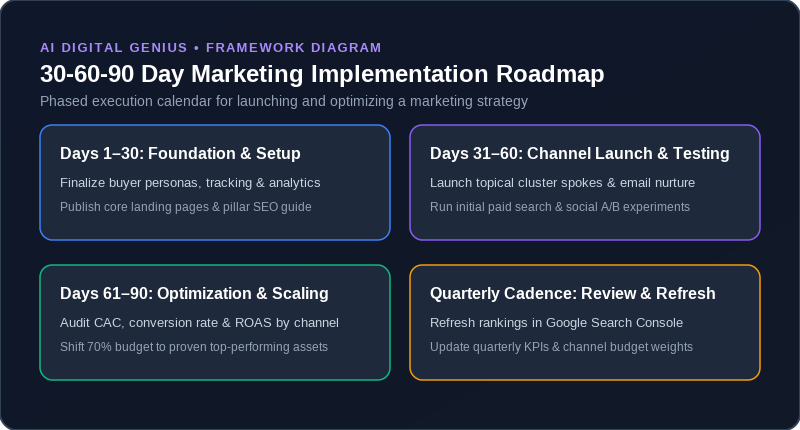
Essential Element #8: Implementation Timeline and Action Plan
The backbone of a successful marketing strategy lies in its implementation timeline and action plan. A well-crafted implementation timeline ensures that all marketing activities are executed in a coordinated and timely manner, helping businesses achieve their marketing objectives.
Creating a Realistic Marketing Calendar
Developing a realistic marketing calendar is crucial for the effective implementation of a marketing plan. This involves:
- Identifying key dates and events relevant to your marketing campaigns
- Planning content and promotional activities around these dates
- Ensuring sufficient lead time for content creation and approval processes
Assigning Responsibilities and Deadlines
For each task outlined in the marketing calendar, it's essential to assign clear responsibilities and deadlines. This includes:
- Designating team members or external partners responsible for specific tasks
- Setting realistic deadlines that account for potential delays
- Establishing a system for tracking progress and addressing any bottlenecks
By creating a detailed implementation timeline and action plan, businesses can ensure that their marketing efforts are well-coordinated, efficient, and effective in achieving their marketing goals.
Essential Element #9: Monitoring and Evaluation Mechanisms
To gauge the success of marketing efforts, businesses must implement robust monitoring and evaluation mechanisms. This involves setting up systems to track performance and making data-driven decisions to optimize marketing strategies.
Setting Up Analytics and Reporting Systems
The first step in monitoring and evaluation is to establish comprehensive analytics and reporting systems. This includes using tools like Google Analytics to track website traffic, social media engagement, and conversion rates. By having a clear picture of how different marketing channels are performing, businesses can identify areas of strength and weakness.
Establishing Review Cycles and Adjustment Protocols
Once the analytics and reporting systems are in place, it's crucial to establish regular review cycles to assess the data collected. This could be monthly, quarterly, or annually, depending on the marketing strategy and goals. During these reviews, businesses should analyze the data to understand what's working and what's not, and make necessary adjustments to their marketing plans.
By implementing these monitoring and evaluation mechanisms, businesses can ensure their marketing efforts are continuously improved and aligned with their overall objectives.
Essential Element #10: Adaptability and Contingency Planning
Adaptability and contingency planning are crucial elements that can make or break a marketing plan. In a rapidly changing business environment, the ability to adapt quickly to new circumstances can be a significant competitive advantage.
Building flexibility into your marketing plan allows businesses to respond effectively to unexpected market shifts. This involves regularly reviewing and updating the marketing strategy to ensure it remains relevant and effective.
Building Flexibility into Your Marketing Plan
To achieve flexibility, marketers should continuously monitor market trends and be prepared to adjust their strategies accordingly. This might involve diversifying marketing channels or developing alternative campaigns to address potential disruptions.
Preparing for Market Changes and Disruptions
Effective contingency planning involves identifying potential risks and developing strategies to mitigate them. By having a plan in place for potential disruptions, businesses can minimize the impact of market changes and maintain a competitive edge.
By incorporating adaptability and contingency planning into their marketing plans, businesses can ensure they are better equipped to handle the challenges of a dynamic market environment.
Leveraging a Free AI Marketing Plan Generator for Optimal Results
In today's fast-paced business environment, leveraging a free AI marketing plan generator can be a game-changer for companies looking to optimize their marketing strategies. The integration of AI in marketing planning is not just a trend; it's a significant shift towards more efficient and effective marketing processes.
How AI Enhances Marketing Planning Efficiency
AI technology brings a new level of sophistication to marketing planning by analyzing vast amounts of data quickly and accurately. This capability allows businesses to make informed decisions based on real-time market analysis and consumer behavior. Structured marketing plans that tie every channel to measurable CAC and LTV benchmarks consistently outperform ad-hoc campaign spending.
Key benefits of AI in marketing planning include:
- Enhanced data analysis capabilities
- Personalized marketing strategies
- Predictive analytics for better decision-making
How to Generate All 10 Marketing Plan Elements Automatically
Instead of piecing together disconnected spreadsheets, you can use the AI Digital Genius Marketing Plan Generator and our companion Marketing Plan Guide & Template:
- Audience & Positioning: Generates customer personas and value propositions anchored in the 4 Ps of marketing.
- Channel & Content Execution: Pairs directly with our AI Blog Generator and topical cluster workflow.
- Budget & ROI Modeling: Applies data-backed marketing budget allocation across paid, owned, and earned channels.
"Technology accelerates research and execution, but sustainable marketing ROI still depends on connecting your product's core value proposition to verified customer needs."
Step-by-Step Guide to Using AI-Generated Marketing Plans
To get the most out of a free AI marketing plan generator, follow these steps:
- Input your business data and marketing objectives
- Customize the generated plan based on your specific needs
- Implement the plan and monitor its performance using analytics tools
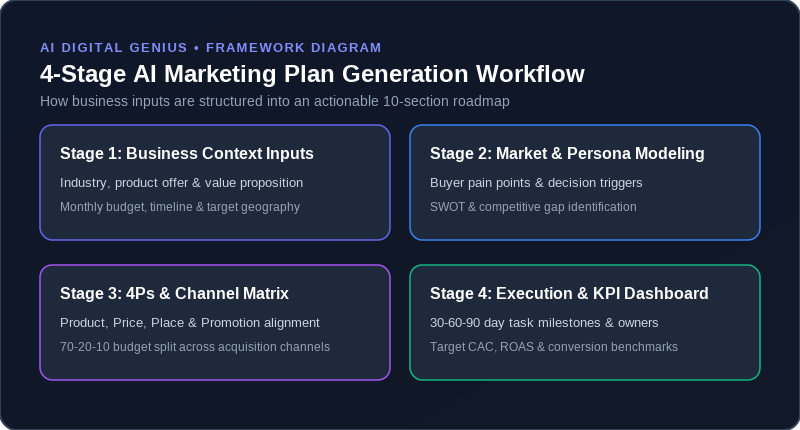
By leveraging a free AI marketing plan generator, businesses can create effective marketing strategies that drive results. As AI technology continues to evolve, we can expect to see even more innovative applications in marketing planning.
Conclusion: Transforming Your Marketing Strategy with the Right Tools and Elements
A well-crafted marketing plan is crucial for businesses aiming to thrive in today's competitive landscape. By incorporating the 10 essential elements outlined in this article, you can develop a comprehensive marketing strategy that drives results.
Utilizing a free marketing plan template can streamline the planning process, ensuring that all critical components are addressed. Furthermore, integrating an AI marketing campaign generator can enhance your strategy by providing data-driven insights and optimizing campaign performance.
By leveraging these tools and adhering to the principles outlined in this article, businesses can create a tailored marketing approach that resonates with their target audience and fosters long-term growth. Effective marketing strategy implementation is key to achieving your business objectives and staying ahead of the competition.
FAQ
What is a free AI marketing plan generator, and how can it help my business?
A free AI marketing plan generator is a tool that uses artificial intelligence to create a customized marketing plan for your business. It can help you identify your target audience, analyze competitors, and develop a marketing strategy that suits your specific needs.
How do I use a business plan generator free to create a marketing plan?
To use a business plan generator free to create a marketing plan, simply input your business information, goals, and objectives into the tool, and it will generate a comprehensive marketing plan tailored to your needs.
What are the essential elements of a successful marketing plan, and how can I incorporate them into my strategy?
The essential elements of a successful marketing plan include clear market research and analysis, defined marketing objectives and KPIs, unique value proposition and positioning, comprehensive marketing mix strategy, content marketing and messaging framework, digital marketing channels and tactics, budget allocation and resource planning, implementation timeline and action plan, monitoring and evaluation mechanisms, and adaptability and contingency planning. You can incorporate these elements into your strategy by using a free AI marketing plan generator or a marketing plan template.
Can I use a project plan generator to create a marketing plan, or do I need a specialized marketing tool?
While a project plan generator can be used to create a marketing plan, a specialized marketing tool like a free AI marketing plan generator is more suitable for creating a comprehensive marketing plan that takes into account the unique needs and goals of your business.
How can I measure the success of my marketing plan, and what KPIs should I track?
To measure the success of your marketing plan, you should track key performance indicators (KPIs) such as website traffic, social media engagement, lead generation, and conversion rates. You can use analytics and reporting systems to track these KPIs and adjust your marketing strategy accordingly.
What is the benefit of using an AI-generated business plan, and how can it help my business grow?
An AI-generated business plan can help your business grow by providing a comprehensive and tailored plan that takes into account your unique needs and goals. It can also help you identify new opportunities and stay ahead of the competition.
Can I use a free marketing plan template to create a marketing plan, or do I need to use a more advanced tool?
You can use a free marketing plan template to create a marketing plan, but a more advanced tool like a free AI marketing plan generator can provide a more comprehensive and tailored plan that takes into account the unique needs and goals of your business.
How can I leverage an AI marketing campaign generator to enhance my marketing efforts?
An AI marketing campaign generator can help you create targeted and effective marketing campaigns by analyzing your business data and developing a customized marketing strategy. You can use this tool to enhance your marketing efforts and drive better results.
Written & Reviewed by Soban Raheel
Founder & Lead StrategistSoban Raheel builds web developer utilities, SEO automation workflows, and data-driven marketing frameworks at AI Digital Genius. Every guide is tested against live search console metrics, RFC/W3C specifications, and practical small-business workflows before publication.
Expert Resources & References
Marketing Plan_Resources
- Free AI Marketing Plan Generator
Turn these 10 essential elements into a tailored marketing plan in minutes.
- Marketing Budget Allocation & ROI Guide
Formulas and channel benchmarks for Element #7 (Budget Allocation & Resource Planning).
- The 4 Ps of Marketing Explained
Deep dive into Element #4 (Product, Price, Place, and Promotion).
Ready to Create Your Marketing Plan?
Use our free AI-powered marketing plan generator to create a comprehensive, data-driven marketing strategy tailored to your business.
Generate Your Marketing Plan