How AI is Revolutionizing Marketing Strategy
The advent of AI-powered marketing is transforming the way businesses approach their marketing strategies. With the ability to analyze vast amounts of data, AI is helping marketers make informed decisions, personalize customer experiences, and optimize their campaigns for better ROI.
One of the most significant benefits of this technological shift is the availability of tools like the free ai marketing plan generator, which enables businesses to create tailored marketing plans without extensive resources or expertise.
As AI marketing strategy continues to evolve, it's becoming increasingly clear that its integration into marketing practices is not just a trend, but a necessity for staying competitive.
Key Takeaways
- Understand how AI is revolutionizing marketing strategies.
- Learn the benefits of using a free AI marketing plan generator.
- Discover how AI-powered marketing can enhance customer experiences.
- Explore the potential of AI in optimizing marketing campaigns.
- Get insights into creating effective marketing plans with AI tools.
The Transformation of Marketing in the AI Era
The rise of AI in marketing is changing how businesses interact with their customers and optimize their campaigns. This transformation is not just about adopting new technology; it's about fundamentally reshaping marketing strategies to be more effective and efficient.
AI-driven marketing is enabling companies to move beyond traditional methods, leveraging data to make informed decisions. This shift is crucial in today's competitive landscape, where businesses need to be agile and responsive to customer needs.
The Shift from Traditional to Data-Driven Marketing
Traditional marketing methods often rely on intuition and broad demographics. In contrast, data-driven marketing uses specific data points to understand customer behavior and preferences. AI enhances this by analyzing vast amounts of data quickly and accurately, providing insights that would be impossible for humans to gather manually.
Why AI is Becoming Essential for Marketing Success
AI is becoming indispensable for marketing success because it allows for personalization at scale. By analyzing customer data, AI can help create targeted campaigns that resonate with individual customers, improving engagement and conversion rates. Moreover, AI's predictive capabilities enable businesses to anticipate customer needs and stay ahead of the competition.
The Competitive Edge of Early AI Adopters
Businesses that adopt AI early gain a significant competitive edge. They can optimize their marketing strategies more effectively, respond to customer needs more quickly, and innovate continuously. Early adopters also have the advantage of shaping their marketing strategies around AI's capabilities, rather than trying to fit AI into existing frameworks.
| Marketing Aspect | Traditional Approach | AI-Driven Approach |
|---|---|---|
| Customer Understanding | Relying on broad demographics and intuition | Using data analytics to understand individual customer behavior |
| Campaign Personalization | Generic messaging for broad audiences | Personalized messaging for individual customers |
| Predictive Capabilities | Limited forecasting based on historical data | Advanced predictive analytics for future trends |
Key AI Technologies Reshaping Marketing Strategy
The integration of AI into marketing has brought about a paradigm shift, leveraging technologies like machine learning and natural language processing to create more effective marketing strategies.
Machine Learning and Predictive Analytics
Machine learning is at the forefront of AI technologies impacting marketing. It enables businesses to analyze vast amounts of customer data, predict future behaviors, and make informed decisions.
How Algorithms Learn from Customer Behavior
Machine learning algorithms learn from customer behavior by analyzing patterns in data, such as purchase history and online interactions. This learning enables businesses to anticipate customer needs.
Turning Data into Actionable Insights
By turning data into actionable insights, businesses can tailor their marketing efforts to specific customer segments, enhancing the effectiveness of their campaigns.
Natural Language Processing for Customer Engagement
Natural Language Processing (NLP) is another crucial AI technology that is reshaping marketing strategies. It allows for more sophisticated customer engagement through chatbots and sentiment analysis.
NLP enables businesses to understand customer sentiment and respond appropriately, improving customer satisfaction and loyalty.
Computer Vision in Visual Marketing
Computer vision is being used in visual marketing to analyze and generate visual content that resonates with target audiences. This technology can help in creating personalized advertisements and product recommendations.
By leveraging computer vision, marketers can enhance the visual appeal of their campaigns and improve customer engagement through more relevant and personalized content.
How AI Enhances Marketing Performance Metrics
The integration of AI in marketing strategies has shown significant improvements in key performance metrics. By leveraging AI-powered marketing tools, businesses can now gain deeper insights into customer behavior, preferences, and trends, allowing for more targeted and effective marketing campaigns.
Improved Customer Acquisition and Conversion Rates
AI-driven marketing enables businesses to identify high-potential customers and personalize their marketing efforts to improve conversion rates. By analyzing customer data and behavior, AI algorithms can predict the likelihood of a customer converting, allowing marketers to focus on high-value prospects.
Reducing Customer Acquisition Costs
AI can help reduce customer acquisition costs by optimizing marketing channels and identifying the most effective campaigns. Through AI-driven marketing optimization, businesses can allocate their marketing budget more efficiently, minimizing waste and maximizing ROI.
Increasing Customer Lifetime Value Through Personalization
Personalization is key to increasing customer lifetime value, and AI is instrumental in achieving this. By analyzing customer data and behavior, AI can help marketers create highly personalized experiences that foster customer loyalty and retention.
Measuring AI's Impact on Marketing ROI
To understand the true impact of AI on marketing ROI, businesses must measure the performance of their AI-driven marketing campaigns. By tracking key metrics such as conversion rates, customer acquisition costs, and customer lifetime value, marketers can assess the effectiveness of their AI-powered marketing strategies and make data-driven decisions to optimize their campaigns further.
🔍 Grounding AI in Marketing Fundamentals
Machine learning algorithms excel at optimizing campaigns across the funnel, but they must be anchored in sound positioning. Review our comprehensive breakdown of the 4 Ps of marketing to see how artificial intelligence supercharges every element of the marketing mix.
AI Applications Across the Marketing Funnel
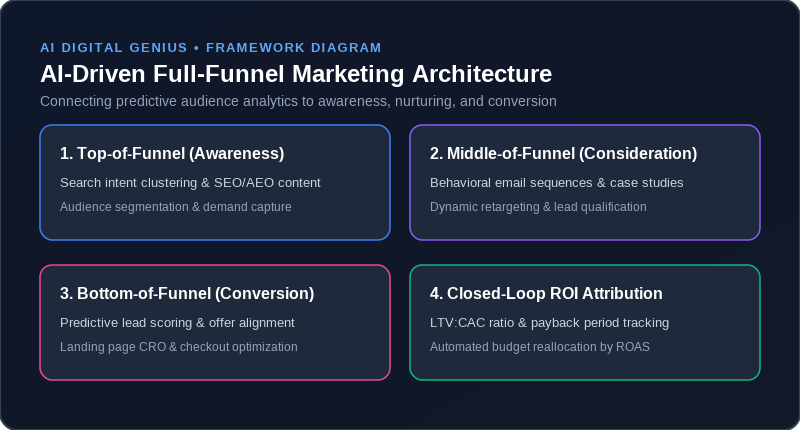
As businesses continue to adopt AI technologies, understanding how to apply them across the marketing funnel is becoming increasingly crucial. The marketing funnel, a model that illustrates the customer journey, is being transformed by AI-driven strategies that enhance efficiency and personalization.
Top-of-Funnel: AI-Powered Content and Awareness Strategies
At the top of the funnel, AI is being used to create engaging content and improve brand awareness. This involves using AI tools for content creation and curation, as well as advanced audience targeting and segmentation.
Content Creation and Curation
AI-powered content generation tools can produce high-quality content, such as blog posts and social media updates, reducing the workload for marketers. Additionally, AI-driven curation tools help in identifying and sharing relevant content that resonates with the target audience.
Audience Targeting and Segmentation
AI enhances audience targeting by analyzing vast amounts of data to identify patterns and preferences. This enables marketers to create highly targeted campaigns that reach the most relevant audiences.
Middle-of-Funnel: Nurturing Leads with AI
In the middle of the funnel, AI is used to nurture leads through personalized communication and smart retargeting strategies.
Personalized Email Campaigns
AI-driven email marketing tools can personalize email content based on user behavior and preferences, increasing engagement and conversion rates.
Smart Retargeting Strategies
AI-powered retargeting strategies help in reaching users who have shown interest in a product or service but haven't converted yet. By analyzing user behavior, AI can optimize retargeting ads for better performance.
Bottom-of-Funnel: AI-Driven Conversion Optimization
At the bottom of the funnel, AI is crucial for optimizing conversions through predictive lead scoring and dynamic pricing strategies.
Predictive Lead Scoring
AI algorithms can score leads based on their likelihood to convert, enabling sales teams to focus on high-potential leads.
Dynamic Pricing and Offer Optimization
AI-driven dynamic pricing tools adjust prices in real-time based on demand, competition, and customer behavior, maximizing revenue and conversion rates.
| Marketing Funnel Stage | AI Application | Benefit |
|---|---|---|
| Top-of-Funnel | Content Creation and Curation | Increased Engagement |
| Middle-of-Funnel | Personalized Email Campaigns | Higher Conversion Rates |
| Bottom-of-Funnel | Predictive Lead Scoring | Improved Sales Efficiency |
Our Free AI Marketing Plan Generator: Your Competitive Advantage
Our Free AI Marketing Plan Generator (alongside our Small Business AI Marketing Strategy Guide and Marketing Budget Allocation Playbook) is designed to help you stay ahead of the competition with personalized marketing plans tailored to your business needs. This innovative tool leverages the latest advancements in AI technology to analyze your business data and create a comprehensive marketing strategy.
How Our AI Analyzes Your Business Needs
The AI marketing plan generator uses a sophisticated algorithm to analyze your business information, including your target audience, industry trends, and competitors. This data is then processed to identify opportunities and challenges, forming the basis of a customized marketing plan.
By understanding your unique business needs, our AI tool can provide actionable insights that help you make informed decisions about your marketing strategy.
The Science Behind Our Personalized Recommendations
Our AI-driven marketing plans are built on a foundation of data-driven insights and industry best practices. The generator uses machine learning algorithms to analyze vast amounts of data, ensuring that the recommendations are not only personalized but also grounded in empirical evidence.
| Feature | Benefit |
|---|---|
| Personalized Marketing Plans | Tailored strategies to meet your unique business needs |
| Data-Driven Insights | Actionable recommendations based on empirical evidence |
| Competitor Analysis | Understand your market position and identify opportunities |
Success Stories: Businesses Transformed by Our Generator
Numerous businesses have achieved significant growth by leveraging our free AI marketing plan generator. From improving brand awareness to driving conversions, our tool has helped businesses across various industries achieve their marketing goals.
By providing a comprehensive marketing strategy, our AI generator empowers businesses to make data-driven decisions and stay competitive in a rapidly evolving market.
Step-by-Step Guide to Creating Your AI Marketing Plan
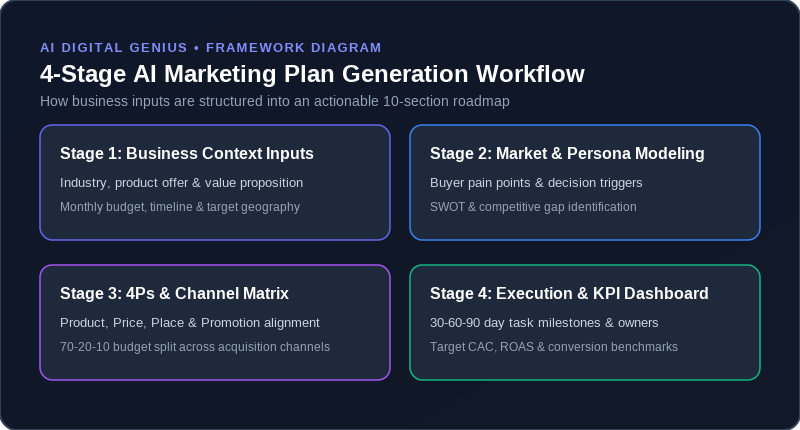
By leveraging our AI marketing tools, you can develop a comprehensive marketing strategy tailored to your business needs. This guide will walk you through the process of creating your AI marketing plan using our AI marketing plan generator.
Inputting Your Business Information
To begin, you'll need to input your business information into our AI marketing plan generator. This includes details about your target audience, marketing goals, and existing marketing strategies. Our AI system will analyze this data to create a personalized marketing plan that addresses your specific needs.
Reviewing and Customizing Your AI-Generated Plan
Once the AI marketing plan is generated, review it carefully to ensure it aligns with your business objectives. You can customize the plan further by adjusting parameters such as budget allocation, marketing channels, and campaign timelines. This step ensures that the final plan is both effective and actionable.
Implementing Your Strategy with Actionable Timelines
With your customized AI marketing plan in hand, the next step is implementation. Our generator provides actionable timelines and specific tasks to help you execute your marketing strategy efficiently. By following these timelines, you can ensure that your marketing efforts are coordinated and effective.
Measuring Results and Refining Your Approach
After implementing your AI marketing plan, it's crucial to measure its performance regularly. Use the insights gained from your marketing analytics to refine your strategy and make data-driven decisions. This ongoing process helps you optimize your marketing efforts and achieve better results over time.
Overcoming Common AI Marketing Implementation Challenges
Despite the potential of AI in marketing, several implementation challenges can arise if not properly managed. As businesses increasingly adopt AI-driven marketing strategies, understanding these hurdles is crucial for success.
Addressing Data Quality and Integration Issues
One of the primary challenges in AI marketing implementation is ensuring high-quality data and seamless integration. To overcome this, businesses should:
- Invest in data cleansing and validation processes
- Implement robust data integration frameworks
- Utilize data quality monitoring tools
Building Team Skills for AI Marketing Success
Another significant challenge is equipping marketing teams with the necessary skills to effectively use AI tools. To address this, companies can:
- Provide comprehensive training programs for marketing staff
- Hire professionals with expertise in AI and data analysis
- Foster a culture of continuous learning and adaptation
Balancing Automation with Human Creativity
Finally, finding the right balance between AI-driven automation and human creativity is essential. Marketers should:
- Use AI for data analysis and repetitive tasks
- Reserve creative decision-making for human teams
- Monitor and adjust the balance between automation and human input
By addressing these common challenges, businesses can more effectively implement AI technology in marketing, leading to improved marketing optimization and better overall results.
Future-Proofing Your Marketing with Emerging AI Trends
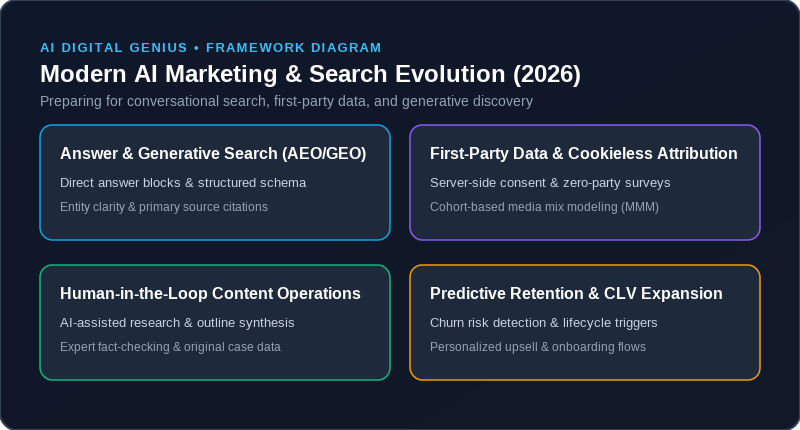
As AI continues to evolve, staying ahead of the curve is crucial for marketers looking to leverage the latest trends. The marketing landscape is constantly shifting, and AI is at the forefront of this change. To remain competitive, businesses must be aware of the emerging trends that are shaping the industry.
Voice Search and Conversational Marketing
Voice search is becoming increasingly popular, and marketers need to adapt their strategies to accommodate this trend. Conversational marketing is key, with a focus on natural language processing and voice-activated interactions. This shift requires brands to rethink their content and engagement strategies to better align with voice search behaviors.
AI-Powered Immersive Experiences
Immersive experiences are another area where AI is making a significant impact. By leveraging AI-powered technologies, marketers can create more engaging and interactive experiences for their customers. This can include virtual and augmented reality experiences that provide new ways to connect with audiences.
Preparing for a Cookieless Future with AI
The move towards a cookieless future is a significant challenge for marketers, but AI can help. By using AI-driven solutions, businesses can develop new ways to track and understand customer behavior without relying on cookies. This involves leveraging alternative data sources and advanced analytics to maintain effective marketing strategies.
| Emerging Trend | Marketing Impact | AI Role |
|---|---|---|
| Voice Search | Conversational Marketing | Natural Language Processing |
| Immersive Experiences | Enhanced Engagement | AI-Powered Technologies |
| Cookieless Future | Alternative Data Strategies | AI-Driven Analytics |
Conclusion: Transform Your Marketing Results with AI-Powered Strategy
As we've explored throughout this article, AI is revolutionizing marketing by enabling businesses to make data-driven decisions, automate repetitive tasks, and personalize customer experiences. By leveraging AI-driven marketing strategies, companies can significantly improve their marketing performance metrics, from customer acquisition to conversion rates.
One of the most effective ways to get started with AI in marketing is by utilizing a free ai marketing plan generator. This tool can help analyze your business needs and provide personalized recommendations for your marketing strategy. By integrating AI-driven marketing into your overall strategy, you can stay ahead of the competition and achieve your marketing goals more efficiently.
As marketing automation continues to evolve, it's essential for businesses to adapt and innovate. By embracing AI-powered marketing strategies, you can unlock new opportunities for growth, enhance customer engagement, and drive long-term success. Take the first step today by exploring the potential of AI in your marketing efforts.
FAQ
What is AI marketing plan generator?
An AI marketing plan generator is a tool that uses artificial intelligence to create personalized marketing plans for businesses. It analyzes business needs and provides tailored recommendations to improve marketing strategies.
How does AI transform marketing strategies?
AI transforms marketing strategies by enabling data-driven approaches, improving customer acquisition and conversion rates, reducing customer acquisition costs, and increasing customer lifetime value through personalization.
What are the key AI technologies used in marketing?
The key AI technologies used in marketing include machine learning, natural language processing, and computer vision. These technologies help businesses to analyze customer behavior, create personalized content, and optimize marketing campaigns.
How can AI enhance marketing performance metrics?
AI can enhance marketing performance metrics by improving customer acquisition and conversion rates, reducing customer acquisition costs, increasing customer lifetime value, and measuring the impact of AI on marketing ROI.
What are the benefits of using a free AI marketing plan generator?
The benefits of using a free AI marketing plan generator include creating personalized marketing plans, improving marketing strategies, and gaining a competitive edge in the market.
How do I get started with creating an AI marketing plan?
To get started with creating an AI marketing plan, you can use a free AI marketing plan generator, input your business information, review and customize the generated plan, and implement it with actionable timelines.
What are the common challenges faced when implementing AI in marketing?
The common challenges faced when implementing AI in marketing include addressing data quality and integration issues, building team skills for AI marketing success, and balancing automation with human creativity.
How can I future-proof my marketing with emerging AI trends?
To future-proof your marketing with emerging AI trends, you can leverage voice search and conversational marketing, AI-powered immersive experiences, and prepare for a cookieless future with AI.
What is the role of machine learning in marketing?
Machine learning plays a crucial role in marketing by enabling businesses to analyze customer behavior, predict customer needs, and create personalized content.
How can AI-powered marketing strategies improve customer engagement?
AI-powered marketing strategies can improve customer engagement by enabling personalized content, improving customer experience, and creating targeted marketing campaigns.
Written & Reviewed by Soban Raheel
Founder & Lead StrategistSoban Raheel builds web developer utilities, SEO automation workflows, and data-driven marketing frameworks at AI Digital Genius. Every guide is tested against live search console metrics, RFC/W3C specifications, and practical small-business workflows before publication.
Expert Resources & References
Industry Trends_&_Insights
- AI Marketing Trends & Insights
Key trends shaping the future of AI in marketing strategies.
- AI Marketing Statistics 2025
Essential statistics on AI adoption and impact.
- 6 Powerful AI Marketing Trends
Expert insights on the transformative power of AI.
- 2025 AI Marketing Landscape
A comprehensive look ahead at major trends for 2025.
- Future of Marketing with AI
Harvard DCE on AI's long-term impact on the industry.
- Marketing Trends 2025 Perspective
Deloitte's strategic view on the future of marketing.
Ready to Create Your Marketing Plan?
Use our free AI-powered marketing plan generator to create a comprehensive, data-driven marketing strategy tailored to your business.
Generate Your Marketing Plan